
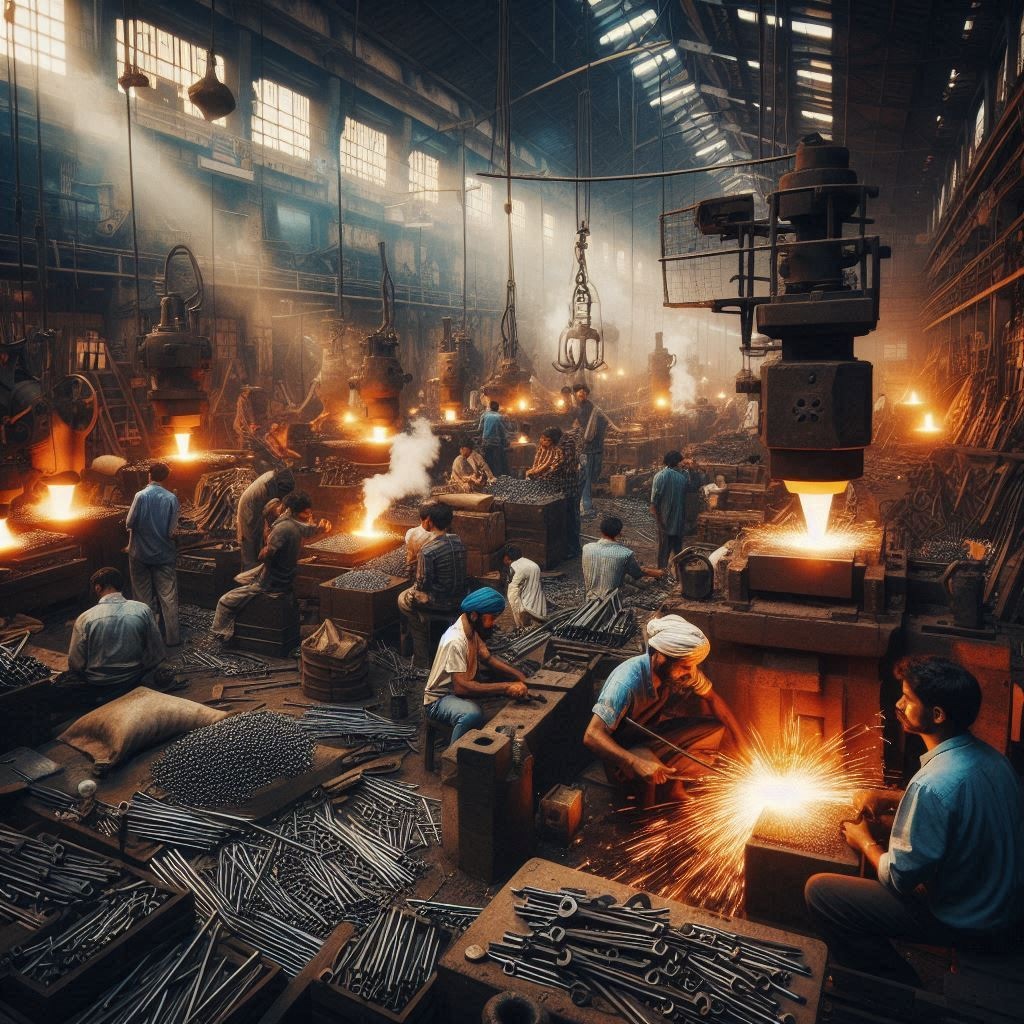
Custom forging decisions rarely hinge on geography alone. The correct location emerges when technical requirements, cost pressure, delivery timelines, and quality expectations intersect without friction. Rajkot has earned relevance in this equation not through branding narratives, but through manufacturing behavior shaped over decades. A forging company in Rajkot operates inside an environment where custom work is not treated as an exception but as a core operating mode.
Understanding when Rajkot becomes the right choice requires looking beyond surface-level advantages and into how custom forgings actually succeed or fail at scale.
Custom Forging Begins with Design Flexibility, Not Equipment Size
Custom forgings fail early when design intent clashes with production reality. Rajkot-based forging clusters developed around varied industrial demand rather than single-product specialization. This history created operational flexibility that favors custom geometries, variable batch sizes, and evolving specifications.
Tooling design capabilities in Rajkot often operate alongside production rather than outside it. Dies are engineered with manufacturability in mind, allowing geometry adjustments without restarting entire programs. Iterative design refinement becomes practical rather than disruptive.
A forging company in Rajkot fits best when part geometry demands collaboration between design intent and forging feasibility instead of rigid process enforcement.
When Volume Falls Between Prototype and Mass Production
Custom forgings often occupy an uncomfortable middle ground. Volumes remain too high for prototype workshops and too low for mass-production plants optimized for repetition.
Rajkot’s forging ecosystem handles this middle volume efficiently. Batch flexibility, moderate press capacities, and adaptable tooling strategies allow economical production without forcing artificial volume inflation. Setup costs remain contained. Changeover losses stay manageable.
This capability matters most for industries requiring phased scaling—initial deployment, controlled ramp-up, and eventual stabilization. In such cases, a forging company in Rajkot delivers continuity without forcing premature volume commitments.
Metallurgical Requirements Drive Location Decisions
Custom forgings frequently demand specific mechanical properties rather than generic strength metrics. Grain flow orientation, fatigue resistance, and impact performance often matter more than tensile strength alone.
Rajkot’s forging operations evolved alongside automotive, tractor, and industrial equipment sectors where metallurgical performance directly affects field reliability. Controlled deformation ratios, disciplined heat treatment cycles, and repeatable material behavior form standard practice rather than premium service.
Custom parts requiring predictable metallurgical response align well with a forging company in Rajkot, where process discipline anchors performance consistency.
Tooling Responsiveness Determines Project Velocity
Custom forging timelines collapse when tooling cycles extend uncontrollably. External tool dependency introduces delays, misalignment, and communication loss.
Rajkot’s manufacturing culture favors in-house or closely networked tooling ecosystems. Die design, modification, and maintenance remain accessible throughout production. Tool wear patterns receive active monitoring rather than reactive replacement.
UNIQUE FORGE reflects this approach through integrated tooling coordination that prioritizes responsiveness over throughput chasing. Tooling agility shortens development cycles without sacrificing dimensional control.
Custom forgings benefit when tooling behaves as a controllable variable rather than a bottleneck.
Cost Sensitivity Without Quality Trade-Offs
Custom parts often attract cost pressure due to non-standard geometry and lower volumes. Cost reduction attempts frequently target inspection relaxation or material substitution—both destructive long-term strategies.
Rajkot’s cost efficiency arises structurally rather than opportunistically. Local supplier density reduces logistics overhead. Skilled labor shortens setup cycles. Process familiarity limits scrap generation. These factors compress cost without touching quality thresholds.
A forging company in Rajkot becomes the right choice when cost sensitivity exists alongside uncompromising quality expectations.
When Iterative Engineering Is Expected, Not Feared
Custom forging projects evolve. Drawing revisions, tolerance refinements, and process adjustments occur as parts encounter real-world loading conditions.
Manufacturing environments that resist iteration slow progress. Rajkot-based forging units expect iteration. Change management systems exist to accommodate engineering updates without destabilizing production.
Revision tracking, controlled revalidation, and documentation discipline prevent silent drift while allowing improvement. Iteration becomes structured rather than chaotic.
Custom forging programs that anticipate evolution benefit from the operational mindset found in a forging company in Rajkot.
Logistics and Lead-Time Predictability Matter
Custom parts often support larger assemblies with fixed launch schedules. Delays cascade quickly across supply chains.
Rajkot’s connectivity to domestic and export logistics networks enables predictable dispatch planning. Inland transport reliability reduces lead-time variance. Export documentation familiarity minimizes administrative friction.
Lead-time predictability matters as much as speed. Custom forging projects succeed when delivery behaves consistently rather than occasionally fast.
When Quality Assurance Must Support Custom Complexity
Custom forgings introduce inspection complexity. Non-standard geometries challenge conventional gauges. Tolerance stacking requires attention.
Rajkot forging units often deploy inspection strategies tailored to custom work: fixture-based measurement, controlled sampling, and process validation over brute-force sorting. Quality assurance focuses on prevention rather than post-production filtering.
A forging company in Rajkot fits best when inspection adapts to geometry instead of forcing geometry to adapt to inspection convenience.
Comparative Indicators for Choosing Rajkot
The table below highlights scenarios where Rajkot aligns strongly with custom forging requirements and where alternate locations may offer better fit.
| Decision Factor | Rajkot Alignment | Alternate Location Fit |
| Custom Geometry Complexity | High adaptability | Limited tooling flexibility |
| Medium Production Volumes | Strong economic fit | Optimized only for mass runs |
| Iterative Design Changes | Supported structurally | Change-resistant environments |
| Cost Sensitivity | Structural efficiency | Cost driven by labor arbitrage |
| Metallurgical Consistency | Proven process control | Inspection-heavy correction |
| Lead-Time Predictability | Stable logistics | Long-distance variability |
These indicators clarify when Rajkot moves from acceptable to strategically correct.
Role of UNIQUE FORGE in Custom Forging Programs
Within Rajkot’s forging landscape, UNIQUE FORGE operates as a representative example of how custom forging capability matures through process discipline rather than scale obsession. Tooling responsiveness, controlled forging practices, and structured quality systems support custom requirements without inflating cost structures.
Such operations demonstrate why Rajkot sustains relevance for custom forgings instead of competing solely on commodity output.
Conclusion: Industry Reality
Custom forging decisions fail when driven by geography alone. Success follows alignment between engineering complexity, volume behavior, cost sensitivity, and operational maturity.
A forging company in Rajkot becomes the right choice when custom requirements demand flexibility without instability, cost efficiency without compromise, and iteration without chaos.
Custom forging rewards control. Rajkot delivers control when conditions match.

![Epoxy Curing Agents Market Growth Analysis Report | Industry Status, Market Opportunities, Key Challenges, Competitive Strategies, Revenue Breakdown, and Forecast Outlook [2025–2034]](https://driftelano.com/wp-content/uploads/2025/12/Epoxy-Curing-Agents-Market.jpg)
![EMI Shielding Market Insights and Analysis [2025–2034] | Industry Performance, Growth Opportunities, Risk Factors, Strategic Developments, and Long-Term Market Projections](https://driftelano.com/wp-content/uploads/2025/12/EMI-Shielding-Market.jpg)

![Dimethyl Ether (DME) Market [Latest Reports] | Business Environment Analysis, Corporate Strategies, Competitive Benchmarking, Investment Trends, and Emerging Market Developments [2025–2034]](https://driftelano.com/wp-content/uploads/2025/12/Dimethyl-Ether-DME-Market.png)
Leave a Reply