
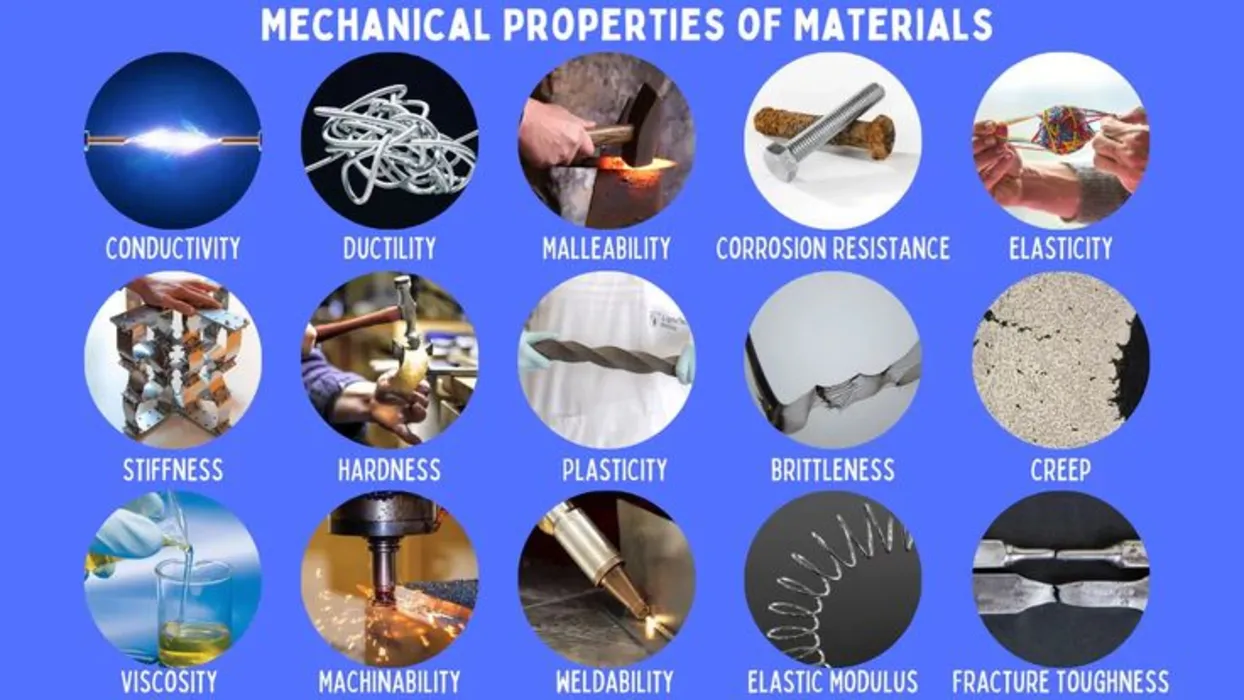
Understanding mechanical properties is essential when selecting materials for manufacturing, engineering, construction, and product design. These properties determine how a material behaves under force, heat, motion, and long-term use. This review explains 15 key mechanical properties, how they differ across common materials, and what engineers should look for when matching materials to real-world applications.
1. Strength
Strength describes the maximum stress a material can withstand before failure.
Steel shows high tensile and compressive strength, which is why it’s used in structural frames. Aluminum offers moderate strength with far lower weight. Polymers tend to have lower strength but are often chosen for flexibility and cost efficiency.
2. Hardness
Hardness measures resistance to indentation or scratching.
Ceramics and tool steels rank among the hardest materials, ideal for cutting tools and wear plates. Softer metals like copper dent more easily but offer better electrical performance. Hardness matters wherever abrasion or surface wear is a concern.
3. Toughness
Toughness is the ability to absorb energy before fracturing.
High-toughness materials like carbon steel can bend or deform before breaking, which is useful in heavy machinery. Glass and ceramics are strong but not tough, so they crack suddenly under impact. Engineers often balance strength and toughness depending on the application.
4. Ductility
Ductile materials stretch before breaking.
Aluminum, copper, and mild steel can be drawn into wires or rolled into thin sheets. Ceramics and cast iron have low ductility and will fracture with little deformation. High ductility is useful for forming processes and for components expected to deform without failing.
5. Malleability
Malleability refers to how well a material can be shaped under compression.
Gold and aluminum are highly malleable. Steel varies depending on alloy and heat treatment. This property is important for rolling, forging, and stamping operations.
6. Elasticity
Elastic materials return to their original shape once stress is removed.
Steel has a well-defined elastic range, making it reliable in load-bearing structures. Rubber is extremely elastic but unsuitable for heavy structural loads. Elasticity affects vibration control, spring design, and component reliability.
7. Plasticity
Plasticity describes permanent deformation once a material passes its elastic limit.
Metals typically show strong plasticity, which allows for shaping during manufacturing. Polymers show different plastic behaviors depending on temperature and formulation. Ceramic components, however, show almost no plasticity.
8. Stiffness
Stiffness measures resistance to elastic deformation.
Carbon fiber composites are light yet extremely stiff, which is why they’re used in aerospace frames and high-performance equipment. Aluminum is less stiff, while rubber is extremely flexible. Stiffness is often a design priority in precision equipment.
9. Creep Resistance
Creep is slow, permanent deformation at constant load over time, especially at high temperature.
Nickel alloys and stainless steels offer strong creep resistance, making them suitable for turbines, boilers, and high-temperature industrial systems. Polymers creep more easily, especially under long-term loads.
10. Fatigue Strength
Fatigue refers to failure under repeated loading cycles.
Steel alloys offer excellent fatigue strength and are commonly used in rotating shafts, automotive components, and aerospace structures. Aluminum has lower fatigue life, which requires careful design considerations.
11. Impact Resistance
Impact resistance determines how a material behaves under sudden forces.
Toughened polymers like polycarbonate resist shattering, making them ideal for safety shields and industrial guards. Ceramics fail quickly under impact. Metals vary widely depending on alloy and heat treatment.
12. Wear Resistance
Wear resistance describes how well a material tolerates surface friction.
Hardened steels, tungsten carbide, and advanced ceramics show excellent wear resistance and are used in bearings, gears, and cutting tools. Softer polymers provide poor wear resistance unless reinforced or lubricated.
13. Thermal Expansion
Different materials expand at different rates when heated.
Ceramics and composites often have low thermal expansion, making them stable under temperature swings. Aluminum expands more, which must be considered in assemblies involving multiple materials to avoid distortion or loosening.
14. Density and Weight
Density influences weight, transportation cost, energy use, and design.
Aluminum is favored for lightweight applications, while steel provides higher strength but at much greater weight. Polymers offer even lighter options but may sacrifice strength or heat tolerance.
15. Modulus of Resilience
This property refers to the energy a material can absorb and release within its elastic range.
Rubber and spring steels are examples of materials with high resilience. This is crucial for shock absorption systems, springs, and vibration control components.
Bringing These Properties Together in Material Selection
There’s no universal “best” material. Engineers must evaluate mechanical properties in context:
- Heavy structural loads: High strength, stiffness, and fatigue resistance (typically steels).
- Lightweight systems: Low density, reasonable strength, and corrosion resistance (aluminum or composites).
- Wear-intensive environments: Hardness and wear resistance (hardened alloy steels, ceramics).
- High-temperature applications: Creep resistance (nickel alloys, heat-resistant steels).
- Impact- or safety-critical parts: Toughness and impact resistance (polycarbonate, treated steels).
A practical approach is to map the required properties to your operational demands, production methods, and lifecycle expectations. This ensures the chosen material performs reliably while controlling cost and complexity.
Conclusion
Mechanical properties guide every critical decision in material selection. Understanding strength, ductility, toughness, creep resistance, and the other properties discussed helps designers and engineers choose materials that improve durability, safety, and performance across industries. As global manufacturing continues to evolve, selecting the right material with the right mechanical profile remains one of the most impactful decisions in any engineering process.
Visit more fasteners website: toko baut & mur – tokohasil.com

![Epoxy Curing Agents Market Growth Analysis Report | Industry Status, Market Opportunities, Key Challenges, Competitive Strategies, Revenue Breakdown, and Forecast Outlook [2025–2034]](https://driftelano.com/wp-content/uploads/2025/12/Epoxy-Curing-Agents-Market.jpg)
![EMI Shielding Market Insights and Analysis [2025–2034] | Industry Performance, Growth Opportunities, Risk Factors, Strategic Developments, and Long-Term Market Projections](https://driftelano.com/wp-content/uploads/2025/12/EMI-Shielding-Market.jpg)

![Dimethyl Ether (DME) Market [Latest Reports] | Business Environment Analysis, Corporate Strategies, Competitive Benchmarking, Investment Trends, and Emerging Market Developments [2025–2034]](https://driftelano.com/wp-content/uploads/2025/12/Dimethyl-Ether-DME-Market.png)
Leave a Reply