
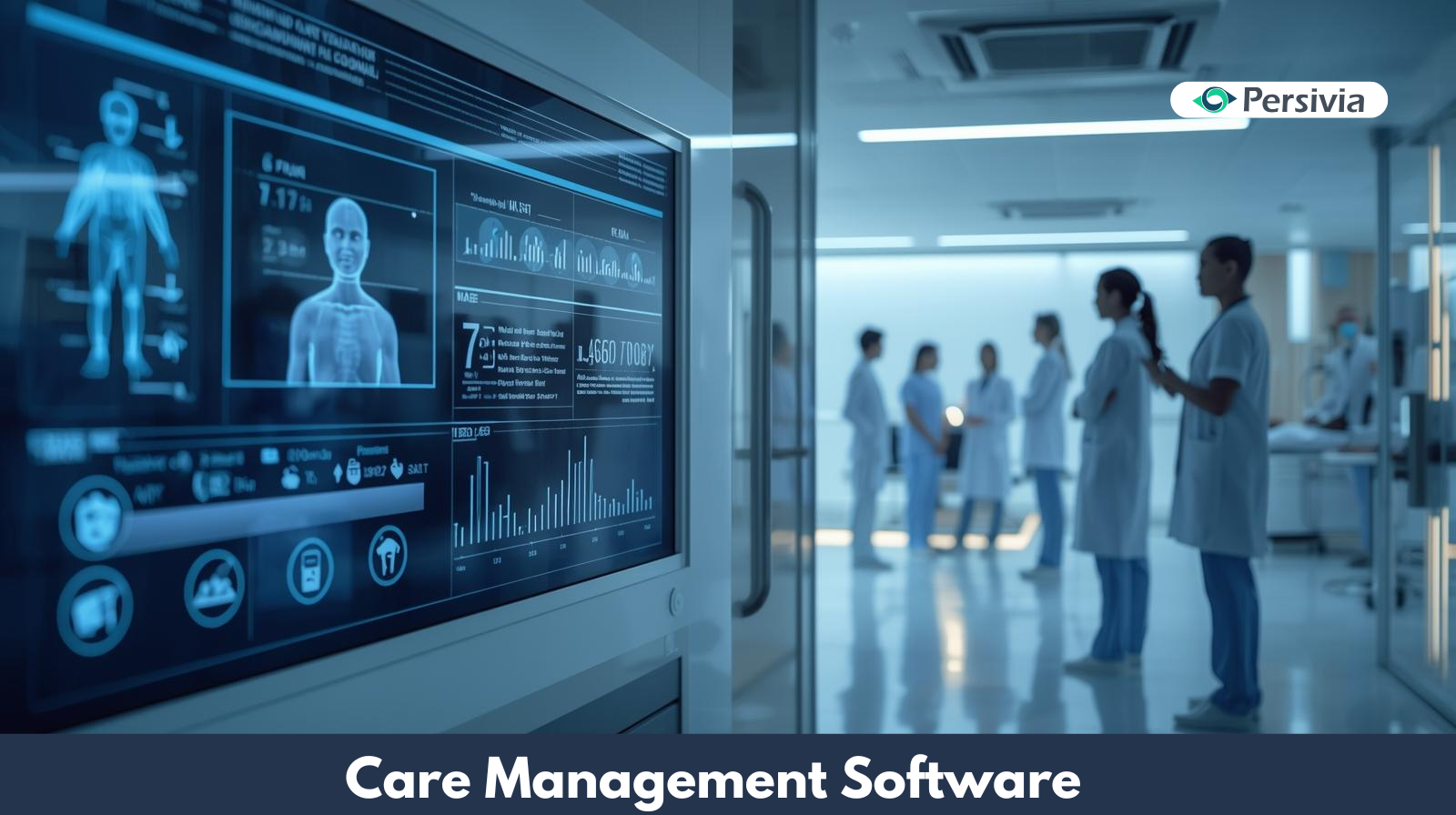
Repetitive tasks like data entry, chart reviews, manual care plan creation, and tracking patient follow-ups are time-consuming activities that waste hours each day for healthcare teams working in disconnected systems. This red tape distracts an administrator and results in a bottleneck that slows down essential interventions. Care management software removes such inefficiencies by automating the workflow and putting patient data in one accessible platform.
In contemporary systems, AI is used to identify high-risk patients, create evidence-based treatment plans, and provide patients with automatic reminders. Care teams can have real-time insight into patient progress by not switching between systems. Automating manual workflows accelerates decision-making, reduces administrative workload, and improves patient outcomes.
What is Care Management Software?
Care management software is an electronic health platform that integrates patient data, automates clinical tasks, and coordinates care delivery across all settings. It combines data in electronic health records, insurance claims, lab results, patient-reported outcomes, and social determinants of health into a single longitudinal record. Care managers can view the entire patient story without having to move through systems or reconcile data manually.
Core Platform Capabilities
- Data integration from clinical, claims, and social sources
- AI-powered risk stratification using machine learning algorithms
- Automated care plan generation based on evidence-based pathways
- Real-time care gap alerts for missing services and overdue screenings
- Patient engagement tools, including portals, apps, and automated messaging
- Telehealth functionality for remote visits and consultations
How Manual Processes Drain Resources
Conventional care coordination relies on manual procedures that take hours each week. Care managers review charts individually, create customized care plans by hand, and track patient compliance in spreadsheets or paper records.
These paper-based processes bring about delays and inaccuracies. The care manager may take 30 minutes to construct a care plan with a patient and then another time to send follow-ups and record each interaction in various systems.
Common Manual Workflow Challenges
- Task fragmentation across disconnected systems creates duplicate data entry. Care managers pull clinical notes from the EHR, claims data from a separate portal, and manually input everything into a care coordination tool.
- Incomplete patient visibility happens when information sits in silos. Providers miss recent hospital visits, medication changes, or social needs documented elsewhere.
- Delayed information flow leads to reactive care. By the time a care manager learns of a hospital admission, the patient may already be home without follow-up.
- Administrative overload prevents teams from scaling. Adding more patients to a program requires hiring more staff rather than working more efficiently.
How Automation Transforms Care Delivery
Repetitive tasks are performed by automation, whereas the care teams work on difficult clinical decisions. The system continuously monitors patient records and notifies patients who require intervention automatically.
The AI algorithms process structured information, such as lab values and claims, as well as unstructured information in clinical notes. The system notifies patients who are at risk of readmission, non-adherence, or disease progression before the issues become severe.
Automated Workflows That Save Time
Smart work queues are based on the priority of patients in terms of risk status and future needs. Patients who are high-risk and have been discharged within a short period of time automatically feature at the top of the daily task lists.
Evidence-based care pathways auto-populate care plans with condition-specific interventions. Care plans are automatically populated with condition-specific interventions based on evidence-based pathways. When a patient who has been recently diagnosed with heart failure is provided with a care plan, a medication regimen, dietary instructions, and follow-up plans are already included in it.
The proactive outreach of patients occurs via automated text messages, emails, and app notifications. Patients receive notifications on medication, appointments, and requests for health assessments without calling.
Care gap closure becomes systematic. The system searches through the missing preventive services, screenings, and problems with medication compliance and notifies the team member in question.
Key Features That Drive Efficiency
The modern platforms constitute several functionalities that used to demand individual tools. This integration will do away with context-switching and establish a smooth workflow between patient identification and intervention and result tracking.
Unified Patient Data View
The platform aggregates every source of information in a single longitudinal record that is updated in real-time. Recent visits, medication changes, lab trends, and patient-reported symptoms are presented in one dashboard by care managers.
This comprehensive view supports faster clinical decisions. A care manager viewing a diabetes patient will be aware of A1C trends, medication fills, visits with the endocrinologist, and whether the patient attended a retinal exam, all without leaving the platform.
AI-Driven Risk Prediction
Machine learning algorithms analyze patient data to predict health risks and potential complications. The risk scores are automatically updated and provided with the new information, making sure that care teams always have current assessments to work with.
The system identifies patients who are prone to hospital readmission, emergency department visits, or lapse in chronic disease care. Early identification enables proactive interventions to prevent costly complications.
Clinical Decision Support at Point of Care
Incident pathways are designed to help with the treatment of chronic conditions, depending on evidence and best practices available. The condition-specific protocols, medication guidelines, and intervention recommendations are made available to care teams when they encounter a patient.
Persivia CareSpace® has more than 200 evidence-based care pathways and 9,000 clinical rules that aid the decision-making process at the continuum of care. These paths streamline consistency and can also be customised to suit the needs of the individual patients.
Manual vs. Automated Care Management
| Aspect | Manual Process | Automated Platform |
| Patient risk assessment | Weekly chart reviews by staff | Real-time AI scoring with automatic updates |
| Care plan creation | 30+ minutes per patient | Auto-generated in seconds with customisation options |
| Care gap identification | Manual record audits | Continuous automated scanning with alerts |
| Patient outreach | Individual phone calls and letters | Automated multi-channel messaging |
| Data aggregation | Manual entry from multiple systems | Automatic integration from all sources |
| Team coordination | Email and phone communication | Integrated task assignment and tracking |
Supporting Value-Based Care Models
Value-based contracts entail the management of population health, bridging of care gaps, and preventable utilisation. These activities can be scaled with the tools that are required to be successful with thousands of patients.
Care management software vendors tailor their products to the needs of value-based care. Characteristics are consistent with standard measures such as readmission rates, quality measure performance, and overall cost of care.
Value-Based Capabilities
- Population health dashboards track performance across quality measures, utilisation metrics, and financial targets. Care teams monitor program success in real-time and identify areas needing attention.
- Quality measure documentation happens automatically as care teams complete clinical activities. The system manages data needed in the HEDIS, Star Ratings, and other quality programs without the need to have individual reporting.
- Cost and utilisation analytics present the trends in emergency department visits, inpatient admissions, and specialist referrals. The high utilizers are identified, and interventions aimed at the high utilizers to minimise unnecessary care are identified by teams.
- Resource optimisation tools help allocate care management resources efficiently. Algorithms suggest optimal caseload distribution based on patient complexity and staff expertise.
What to Look for When Choosing a Platform
The best care management software is more than just simple care coordination. The appropriate platform offers rich clinical content, scalable architecture, and compatibility with current systems.
Essential Selection Criteria
- Clinical content depth matters for rapid deployment. Evidence-based pathways, assessment templates, and intervention libraries are built into platforms, which cut down on setup time and provide clinical quality.
- Interoperability standards allow data sharing with EHRs, claims systems, and other health IT devices. Search for support of HL7, FHIR, and standard API protocols.
- Clinical teams can modify workflows, care pathways, and risk models without having to wait until IT support is available due to user-friendly configuration. They should have the ability to change hands-on by the non-technical users.
- Mobile functionality supports care managers working in community settings. The mobile devices can access the entire platform, making them productive wherever one is.
- Scalability supports the expansion of pilot programs to enterprise implementation. The system must be able to manage the rising patient volumes and other models of care without deterioration of performance.
Implementation Approach
Successful implementations start focused and expand based on proven results. Organisations that try to deploy across all programs simultaneously often struggle with change management and workflow disruption.
Phased Rollout Strategy
- Use a pilot population to check workflows and collect responses.
- Choose a care model where staff are receptive to new tools and success metrics are clearly defined.
- Conduct training on the fundamental processes of work using practical sessions on day-to-day activities. Role-specific training will help each member of the team acquire useful functionality.
- Track adoption through login frequency, care plan completion rates, and feature usage. A low adoption indicates that there is a gap in training or workflow resistance that should be overcome.
- Expand systematically after proving value with the pilot.
- Use early wins to build organisational confidence and secure support for broader rollout.
Measuring Real-World Impact
The improvement of efficiency is significant, but clinical outcomes prove their worth. Measure indicators that demonstrate positive patient health, costing, and productivity of the care team.
Key Performance Indicators
- Readmission rates for target conditions
- Emergency department utilisation frequency
- Preventive care completion percentages
- Medication adherence for chronic disease patients
- Care plan completion rates by care managers
- Patient engagement is measured through portal usage and assessment completion.
Regular reporting keeps stakeholders informed and demonstrates return on investment for technology and program costs.
Key Takeaway
Healthcare organisations cannot afford to have care teams preoccupied with the administrative side of the business when patients require clinical knowledge and one-on-one care. The proper platform increases the effectiveness of teams by means of intelligent automation, at the same time preserving the human touch that is the key to successful care management.
CareSpace® is an integrated care management platform offered by Persivia and based on AI technology, and follows patients throughout the continuum of care. Clinical decision support: Thousands of evidence-based algorithms, automated care gap detection, real-time risk stratification, and point-of-care systems are integrated into one platform. Care teams become more efficient than ever, providing scale with coordinated and individualised care. Eliminate manual processes and improve patient outcomes through automated, data-driven care management.
FAQs
- Does care management software integrate with existing EHR systems?
Yes, modern platforms connect with most EHR systems through standard protocols like HL7 and FHIR, ensuring seamless and automatic data exchange.
- Can small practices benefit from care management software?
Yes, cloud-based care management platforms scale easily, making them suitable for small clinics managing hundreds of patients as well as large health systems.
- How long does staff training typically take?
Most platforms offer role-based training that can be completed within one to two weeks. Ongoing support is also available as teams adapt to new workflows.
- Will the platform work for multiple payer contracts?
Yes, enterprise platforms are designed to support multiple value-based contracts, quality programs, and population health requirements within a single system.
- Does care management software require dedicated IT staff?
No, many solutions include user-friendly configuration tools that allow clinical teams to update workflows, care pathways, and automation rules without heavy IT involvement.

![Epoxy Curing Agents Market Growth Analysis Report | Industry Status, Market Opportunities, Key Challenges, Competitive Strategies, Revenue Breakdown, and Forecast Outlook [2025–2034]](https://driftelano.com/wp-content/uploads/2025/12/Epoxy-Curing-Agents-Market.jpg)
![EMI Shielding Market Insights and Analysis [2025–2034] | Industry Performance, Growth Opportunities, Risk Factors, Strategic Developments, and Long-Term Market Projections](https://driftelano.com/wp-content/uploads/2025/12/EMI-Shielding-Market.jpg)

![Dimethyl Ether (DME) Market [Latest Reports] | Business Environment Analysis, Corporate Strategies, Competitive Benchmarking, Investment Trends, and Emerging Market Developments [2025–2034]](https://driftelano.com/wp-content/uploads/2025/12/Dimethyl-Ether-DME-Market.png)
Leave a Reply