
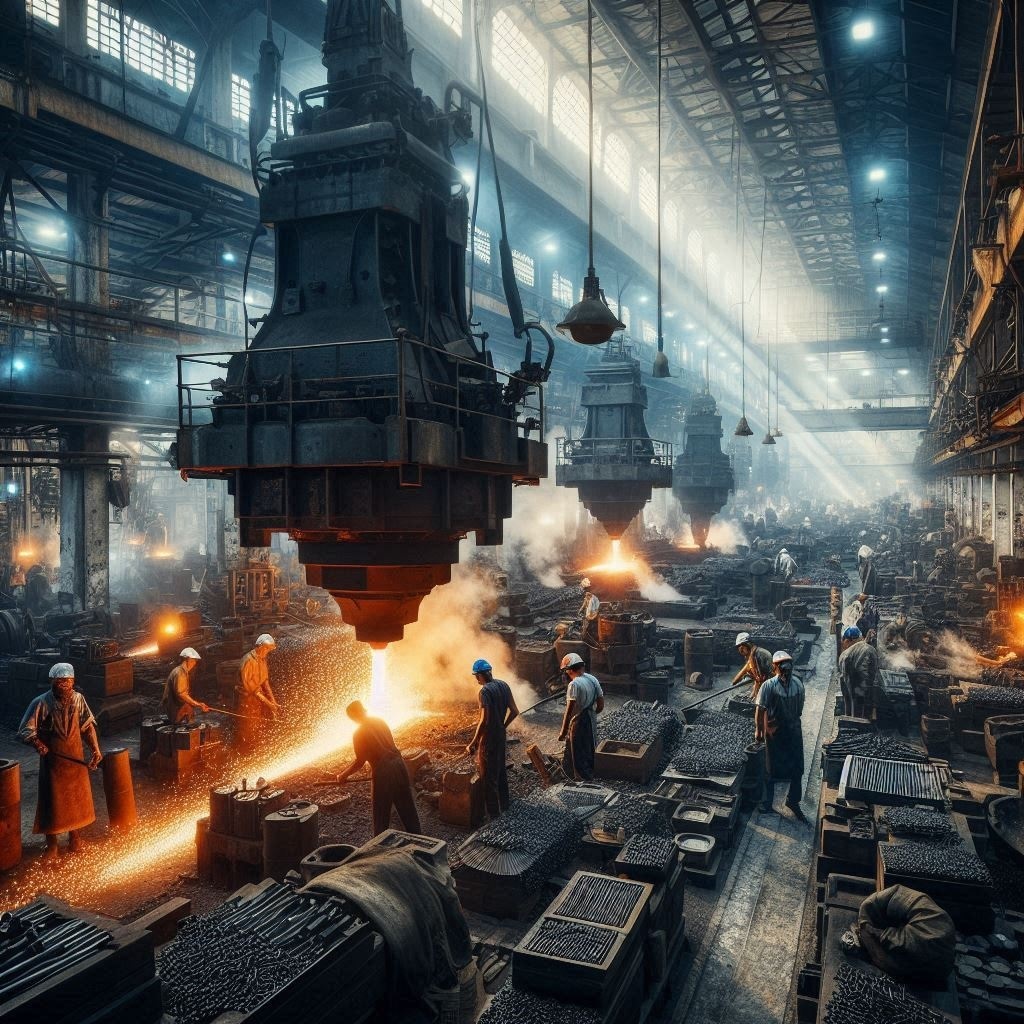
OEM sourcing decisions rarely fail because of price alone. They fail because a supplier cannot hold tolerance when volume rises, cannot repeat metallurgy batch after batch, or cannot react when design pressure changes midway through a product lifecycle. Forging sits at the center of that risk. It is not cosmetic manufacturing. It defines structural integrity, fatigue life, and downstream machining success. That is precisely where India’s forging sector has earned long-term relevance.
What follows is not a surface-level view. It is a ground-up look at why OEMs—particularly those operating in automotive, off-highway, rail, energy, and industrial equipment—continue to deepen engagement with forging companies India instead of treating them as secondary sourcing options.
India’s Forging Ecosystem Is Built Around Load, Not Appearance
Forging in India evolved around function-first industries. Tractor axles. Transmission components. Crankshafts. Steering knuckles. These parts are punished daily under cyclic loads, shock, vibration, and temperature variation. That legacy matters.
Unlike regions where forging is often an extension of machining, Indian forging culture starts with grain flow, not finish.
Metallurgy is treated as a performance variable
Steel selection is rarely generic. Carbon range, alloying balance, cleanliness, and heat-treatment response are evaluated against real-world loading conditions. That approach directly benefits OEMs chasing durability targets without inflating part mass.
Forging geometry is optimized for stress paths
Indian forging engineers routinely modify geometry to align material flow with force direction. The result is higher fatigue resistance using the same raw material grade—something machining alone cannot replicate.
This focus explains why forging companies India continue supplying safety-critical components globally without structural compromise.
Cost Efficiency That Comes from Structure, Not Corner-Cutting
The cost advantage India offers is often misunderstood. It is not rooted in cheap execution. It comes from industrial structure.
Steel mills, die manufacturers, heat-treatment shops, machining vendors, and logistics providers operate inside tightly connected clusters. That proximity reduces waste, rework, and delay—costs that rarely show up on quotations but destroy margins later.
Tooling economics favor long OEM programs
Die life is taken seriously because replacement disrupts schedules. Tool steels, die design, and maintenance cycles are optimized to extend usable life across high-volume runs. For OEM platforms spanning several years, this discipline translates into stable cost curves.
Labor skill density offsets automation gaps
Forging remains a hands-on discipline. Indian plants benefit from technicians who understand deformation behavior instinctively. This reduces setup scrap, trial iterations, and quality drift—hidden costs that often exceed automation savings elsewhere.
For OEMs, forging companies India deliver pricing stability, not just low initial quotes.
Engineering Engagement Happens Before Production Begins
OEMs do not need suppliers who simply accept drawings. They need partners who question them—constructively.
Indian forging suppliers have grown accustomed to early-stage engineering collaboration because many export customers demand it. That expectation is now embedded in how programs are approached.
Design-for-forging input is routine
Section transitions, fillet radii, draft angles, and flash management are reviewed upfront. Minor design changes at this stage often remove entire machining steps later, improving cost and structural integrity simultaneously.
Heat treatment is not treated as an afterthought
Normalizing, quenching, tempering, and induction hardening routes are selected based on service life, not habit. That level of process tailoring significantly improves consistency once volumes scale.
OEMs working with forging companies India gain access to this thinking early, when change is still inexpensive.
Production Consistency Matters More Than Showcase Samples
One-off sample approval means nothing if the 10,000th part behaves differently.
Indian forging operations are designed around repeatability because domestic OEMs demand it. Automotive and tractor manufacturers apply relentless pressure on consistency, and suppliers have adapted accordingly.
Process control is embedded, not layered on
Billet temperature, forging pressure, die wear, and cooling rates are monitored as part of normal production flow. Deviations are corrected immediately, not investigated weeks later.
Inspection supports production, not policing
Dimensional checks, hardness testing, and NDT are integrated into throughput. This keeps feedback loops short and prevents defect migration downstream.
This operational discipline is why forging companies India remain trusted for high-volume, safety-sensitive supply.
Vertical Integration Reduces OEM Risk
Supplier fragmentation introduces delay, blame-shifting, and quality gaps. Indian forging suppliers increasingly counter this by offering integrated capability.
Forging-to-machining continuity improves accuracy
Machining allowances are set by the same team that controls forging deformation. This alignment improves concentricity, surface finish, and tolerance retention after heat treatment.
Logistics and packaging are production-aware
Export packaging, corrosion protection, labeling, and sequencing are handled with assembly-line realities in mind. Components arrive usable, not just delivered.
OEMs benefit from fewer interfaces and clearer accountability when working with forging companies India.
Capacity Scaling Without Chaos
OEM demand rarely stays flat. New variants launch. Export markets open. Volumes double faster than forecasts predicted.
Indian forging plants are accustomed to this volatility.
Press capacity is deliberately oversized
Many facilities maintain surplus forging capacity to accommodate spikes without degrading quality. Multi-shift operations are normalized, not reactive.
Workforce flexibility supports ramp-ups
Cross-trained teams allow rapid output increases without compromising process knowledge. This prevents the common failure mode of scaling through inexperienced labor.
This scalability is a practical advantage that OEMs often underestimate until it is needed.
Export Readiness Is No Longer Optional—and India Is Ready
Indian forged components ship globally every day. That experience shows.
Packaging standards protect machined surfaces over long transit cycles. Documentation aligns with international compliance requirements. Lead times account for port congestion, customs clearance, and inland logistics.
OEMs sourcing from forging companies India avoid the learning curve that often accompanies new export suppliers elsewhere.
Technology Adoption Is Quiet but Real
Not every plant markets digital transformation loudly. That does not mean it is absent.
Forging simulation tools are used to refine die design before steel ever heats up. Data collection supports traceability and root-cause analysis. Preventive maintenance scheduling reduces unplanned downtime.
Technology is applied where it improves reliability, not where it looks impressive in brochures.
Where UNIQUE FORGE Fits into This Landscape
Within India’s forging ecosystem, UNIQUE FORGE reflects the direction serious OEM-aligned suppliers are moving. Closed-die forging capability, controlled heat treatment, and machining integration are structured around repeatability rather than short-term throughput. That alignment supports OEM expectations for dimensional stability, metallurgical consistency, and delivery reliability across extended programs.
The Real Advantage Is Strategic, Not Transactional
OEMs do not stay with suppliers for decades because of price. They stay because failure rates stay low, communication stays clear, and production stays predictable even when conditions shift.
That is the real value delivered by forging companies India. Structural integrity. Process discipline. Scale without instability. Engineering support without friction.
For OEMs building platforms meant to last years—not quarters—India’s forging sector continues to prove its relevance where it matters most: inside the metal itself.
Risk Mitigation and Long-Term Reliability in OEM Forging Partnerships
Forging failures rarely announce themselves early. They surface after thousands of operating hours, under peak load, in the field—where recalls are expensive and reputation damage is permanent. That reality makes risk mitigation one of the most practical reasons OEMs gravitate toward mature forging ecosystems rather than chasing short-term savings.
India’s forging sector has been shaped by industries that tolerate zero ambiguity around failure. This has driven a mindset where prevention outweighs correction.
Where Indian forgers reduce OEM exposure
Several structural behaviors consistently lower risk for OEM programs:
- Conservative process windows instead of aggressive throughput targets
- Early flagging of material or geometry risks before tooling investment
- Preference for repeatable process routes over experimental shortcuts
- Willingness to reject non-conforming raw material rather than “process around” it
This discipline becomes visible when comparing supplier behavior across critical decision points.
Practical comparison of forging supplier risk profiles:
| Evaluation Area | Mature Indian Forging Supplier | Low-Maturity Global Alternative |
| Tooling philosophy | Designed for long die life and stable flow | Optimized for lowest upfront cost |
| Material acceptance | Tight chemistry and cleanliness control | Wider acceptance range to avoid delays |
| Process deviation response | Immediate correction, root-cause driven | Defer correction to meet shipment |
| Volume ramp handling | Planned capacity buffers | Reactive outsourcing or overtime |
| Engineering feedback | Pushback on risky geometry | Silent compliance with drawings |
| Failure accountability | Process traceability maintained | Fragmented responsibility |
This difference explains why forging companies India are often retained across multiple OEM platforms once proven, even when alternative suppliers appear cheaper on paper.
Conclusion
Forging decisions shape product life far beyond the factory floor. When components must survive load, fatigue, and time without compromise, supplier capability becomes a strategic variable—not a procurement line item.
India’s forging sector delivers value where it matters most: in metallurgical consistency, process discipline, engineering collaboration, and the ability to scale without instability. These are not abstract advantages. They translate directly into lower field failures, smoother launches, and predictable lifecycle performance.
For OEMs building platforms meant to endure real-world punishment, partnerships with forging companies India remain grounded in one enduring truth—the strongest advantage is reliability that does not need explanation.

![Epoxy Curing Agents Market Growth Analysis Report | Industry Status, Market Opportunities, Key Challenges, Competitive Strategies, Revenue Breakdown, and Forecast Outlook [2025–2034]](https://driftelano.com/wp-content/uploads/2025/12/Epoxy-Curing-Agents-Market.jpg)
![EMI Shielding Market Insights and Analysis [2025–2034] | Industry Performance, Growth Opportunities, Risk Factors, Strategic Developments, and Long-Term Market Projections](https://driftelano.com/wp-content/uploads/2025/12/EMI-Shielding-Market.jpg)

![Dimethyl Ether (DME) Market [Latest Reports] | Business Environment Analysis, Corporate Strategies, Competitive Benchmarking, Investment Trends, and Emerging Market Developments [2025–2034]](https://driftelano.com/wp-content/uploads/2025/12/Dimethyl-Ether-DME-Market.png)
Leave a Reply